

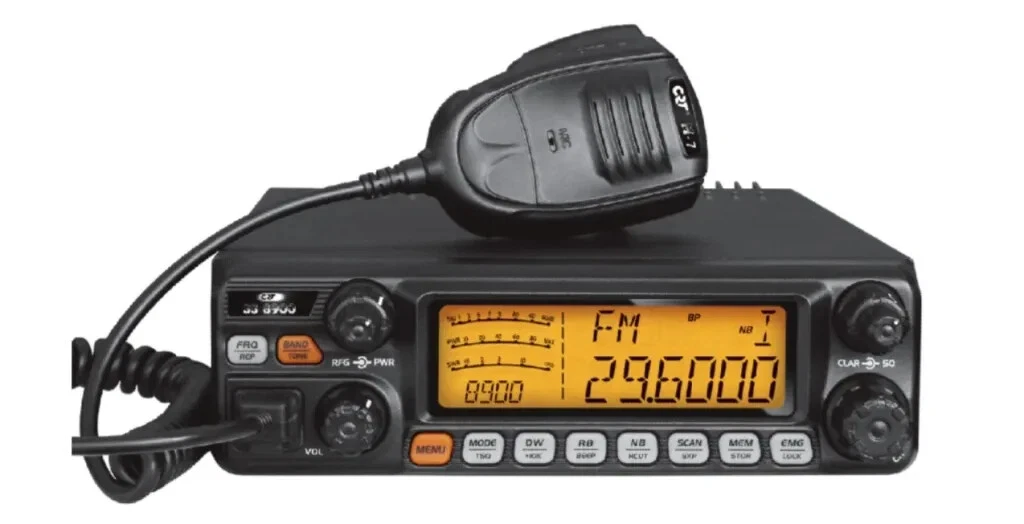
A 10 metre radio is a mobile transceiver for the 28.000 to 29.700 MHz amateur band, usually with AM, FM, USB, LSB and CW. SSB means single sideband: one sideband transmitted, the carrier suppressed. Transmitting on 28 MHz needs an amateur licence. A 27 MHz CB set does not.
On a dashboard they look alike: a mobile box, a hand microphone, an SO239 socket. What separates them is where they transmit.
What is a 10 metre radio?
A 10 metre radio is a mobile transceiver built for the amateur allocation at 28 MHz. The Moonraker Titan 10m transceiver shows the shape of the class in its own specification: 28.000 to 29.700 MHz, mode AM/FM/USB/LSB/CW/PA, output adjustable from a low setting of around 200 mW to a high of around 40 W. Moonraker notes that the variable control suits driving an external amplifier at low power. Channel layout is software too: the AnyTone ARES II lists a programmable 28.000 to 29.695 MHz.
10 metre radio vs CB: what actually differs
Band, licence status, modes and power. The mount, coax and microphone are shared. The figures below are the manufacturers’ own.
| Set | Frequency range | Modes | Quoted transmit power |
|---|---|---|---|
| PNI Escort HP 9001 PRO | 26.965 to 27.405 MHz | AM, FM | 4 W |
| Super Star SS 3900 | 26.565 to 27.99125 MHz | AM, LSB, USB, FM | 4 W AM/FM, 12 W SSB |
| CRT SS 6900V | 28 to 29.7 MHz | AM, FM, USB, LSB, CW, PA | 12 W AM, 40 W FM, 35 W (listed as BLU) |
| CRT SS 8900 | 28 to 29.7 MHz | AM, FM, LSB, USB, CW | 60 W PEP AM, 50 W FM, 60 W PEP SSB |
| Moonraker Titan | 28.000 to 29.700 MHz | AM, FM, USB, LSB, CW, PA | around 200 mW to 40 W |
| Anytone 5555 PLUSN | 28 MHz band | AM, FM, SSB, CW | 12 W max AM/CW, 40 W max FM/SSB |
The first two rows are 27 MHz sets, the rest 28 MHz amateur sets. The licence position decides what you may switch on.
Do you need a licence for a 10 metre radio?
Yes. Section 8 of the Wireless Telegraphy Act 2006 makes it unlawful to establish or use a wireless telegraphy station, or to instal or use wireless telegraphy apparatus, except under and in accordance with a licence granted by Ofcom. No exemption covers amateur use, so transmitting between 28 and 29.7 MHz means an amateur licence, starting in the UK with the Foundation licence the RSGB calls your gateway to the world of amateur radio.
CB is the exception, and it is worth naming the right instrument. The Wireless Telegraphy (Exemption and Amendment) (Amendment) Regulations 2014 inserted a regulation 10, Citizens’ Band Radio Equipment, into the 2010 exemption regulations, exempting from section 8(1) apparatus that complies with IR 2027.2, Ofcom’s interface requirement for AM, SSB and DSB use in the Citizens’ Band Radio Service, provided it causes no undue interference. Channels and power limits are covered in our guide on whether CB radio is legal in the UK.
That matters when a set advertises extended coverage. The Titan listing mentions an export mode, the SS 3900 an export modification. Extended coverage does not extend permission.
What is SSB radio and what is SSB radio used for?
An AM signal carries a carrier and two sidebands, with the voice in the sidebands. Single sideband removes the carrier and one sideband, leaving USB or LSB, so the transmitter’s effort goes into the speech rather than into a carrier that carries no information. That is why operators reach for sideband when conditions are marginal.
The ratings show the effect, though not as a clean power advantage. The Super Star SS 3900 quotes 4 W on AM and FM and 12 W on sideband from the same box. The CRT SS 8900 quotes 60 W PEP on AM, 50 W FM and 60 W PEP SSB, so sideband matches AM rather than beating it, while the CRT SS 6900V is quoted at 40 W FM against 35 W on what its listing calls BLU. A PEP figure is a peak figure and does not compare directly with an FM rating.
As general behaviour rather than measurable numbers, FM stays clean until the signal falls below the receiver’s threshold and then goes, AM degrades more gradually, and SSB sounds thin unless tuned precisely, because no carrier anchors the pitch. That is what a clarifier is for: the SS 6900V lists a multifunction clarifier that clarifies the voice in SSB, and the Anytone 5555 PLUSN lists multiple clarifier operating modes. Filtering counts too: the Titan lists a Hi-Cut filter and noise blanker, the SS 8900 an NRC filter.
10 metre radio range: the honest answer
No honest figure in miles can be given. Ground wave at 28 MHz is local and terrain dependent, and the distances people have in mind come from ionospheric propagation, which changes with the solar cycle and season.
The RSGB puts it plainly on its 28 MHz page: 10 metres can seem very empty during the years of sunspot minima, while during sunspot maxima it can be open worldwide, with contacts easy using low power and simple antennas. Summer sporadic E, it adds, is very common and gives very strong signals around Europe.
10 metre radio frequencies: where the activity sits
Activity is grouped by mode. The RSGB band plan shows CW from 28000 kHz, data from 28070, beacons from 28190, SSB from 28300 to 29000, all modes to 29300, satellite to 29520 and FM to 29700 kHz, with AM also found in the 29.0 to 29.1 MHz range. These indicate predominant use, so read the detailed plan for permitted modes.
Antennas and coax for 28 MHz
You often do not need a new antenna. Plenty of 27 MHz whips are designed to tune up to 30 MHz and say so. The Sirio Bull Trucker 5000 lists 27 to 30 MHz and tunable systems of CB 27 MHz and 10m HAM, and other whips in our mobile CB antennas range say the same.
Check the quoted range first. The Sirio 827 is described as ideal also for amateur use on the 10 m band, yet its own frequency range is given as 26 to 28 MHz. For base use across both, the Prosistel PST-1011J is specified tunable from 27 to 30 MHz. On mounts, our vehicle antenna guide applies unchanged.
Tune it before you transmit
An antenna tuned at 27 MHz is not tuned at 28 MHz. Retune it with a meter that covers the frequency and the power. Among our SWR meters the Moonraker SWR-125 is specified 26 to 30 MHz at 100 W, the SWR-200 1.8 to 160 MHz. Our SWR guide sets out the method.
Power and feeder at home
A 40 to 60 W set asks more of the supply than a 4 W CB. The SM30 SWI is a switch mode unit listed at 13.8 V DC fixed, 20 A constant with a 30 A peak; size it against the current figure in your radio’s manual, not against its transmit power. The RG213 mil spec cable in our coax range is described as a lower loss solution for long runs at high power: 50 ohm, 9 mm, quoted loss 0.7 dB per 10 m at 100 MHz. That is a 100 MHz figure, and loss at 28 MHz is lower.
Which set suits whom
- Licensed amateur, simple 10 m mobile. The CRT SS 6900V or the Titan, on a 27 to 30 MHz whip.
- Sideband on 27 MHz. The Super Star SS 3900, on the permitted UK channels.
- Local UK road traffic only. A 4 W AM/FM CB such as the PNI Escort HP 9001 PRO or TTI TCB 900.
Frequently asked questions
Do you need a licence for a 10 metre radio?
Yes. The 28.000 to 29.700 MHz band is amateur spectrum, and section 8 of the Wireless Telegraphy Act 2006 makes it unlawful to use a wireless telegraphy station or apparatus except under a licence, unless an exemption applies. None covers amateur use, so you need an amateur licence, which in the UK starts with the RSGB Foundation course and exam.
Is a 10 metre radio a CB?
No. It mounts like one, but it transmits on the 28 MHz amateur band rather than the 27 MHz Citizens’ Band allocation. CB apparatus complying with Ofcom’s IR 2027.2 is exempt from section 8(1) under regulation 10 of the 2010 exemption regulations. A 10 metre set is not.
What is SSB radio used for?
Sideband is used where conditions are marginal, because suppressing the carrier puts the transmitter’s effort into the speech. Ratings vary by set: the Super Star SS 3900 quotes 4 W on AM and FM against 12 W on SSB, the CRT SS 8900 60 W PEP on both AM and SSB.
How far can a 10 metre radio transmit?
There is no honest answer in miles. Ground wave is local and terrain dependent, and longer contacts depend on ionospheric propagation. The RSGB notes that 10 metres can seem very empty during sunspot minima yet be open worldwide during sunspot maxima, and that summer sporadic E gives very strong signals around Europe.
Is a CB radio AM or FM?
UK CB sets are generally both. The PNI Escort HP 9001 PRO lists AM and FM across 40 channels at 4 W, and the TTI TCB 900 lists 4 W with AM/FM operation subject to country regulation. Sideband on 27 MHz is found only on all mode sets such as the Super Star SS 3900.