

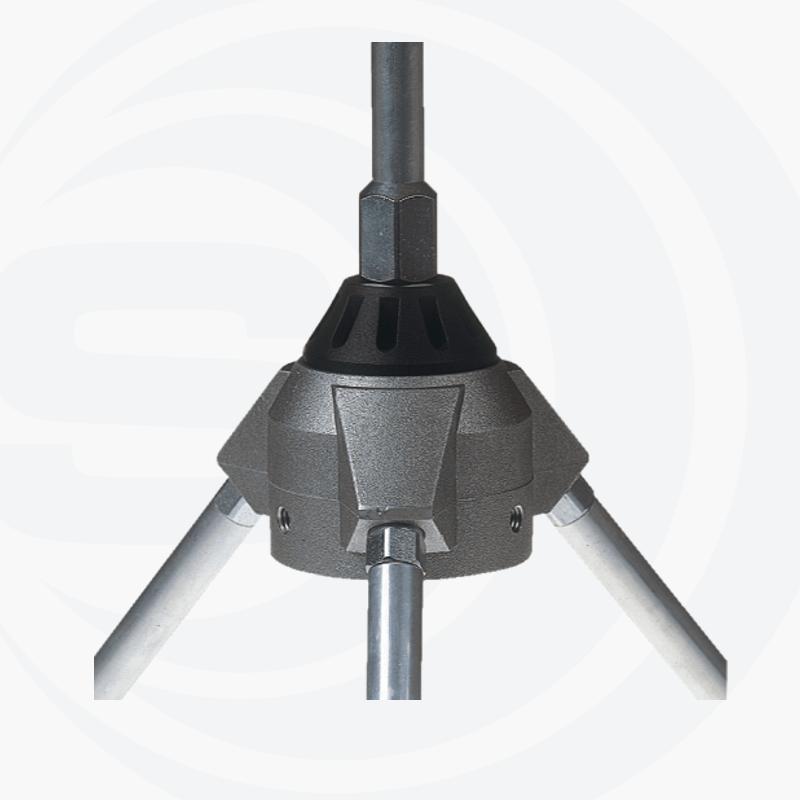
A CB base station antenna setup is a vertical antenna clamped to a mast so it clears the roofline, radials in free air all round, fed by one continuous run of 50 ohm coax to a 13.8 V supply and radio indoors, then checked on an SWR meter in its final position.
Home installations go wrong in the same five places: the antenna sits too low, the radials touch something, the bracket is under rated, the cable is longer than anyone measured, or the SWR was never rechecked at height.
What a CB base station antenna setup is made of
- The antenna: length, weight, wind surface, mast range.
- The mast and mounting: bracket, lashing or guyed pole.
- The radials, needing a clear circle around the mast.
- One continuous coax run to the shack.
- Radio, 13.8 V supply and SWR meter indoors.
Before any of it, read our guide on whether CB radio is legal in the UK. In short, 27 MHz CB is licence exempt under the Ofcom exemption regulations at 4 watts on FM and AM across the 40 UK and EU channels, while the 28 to 29.7 MHz 10 metre band needs an amateur licence. Several of these antennas cover both.
Height above the roofline: what it actually buys you
The rule of thumb at 27 MHz is that clearance beats raw height. An antenna below the ridge fires into slate and brick on one side. Lift the feed point and radials clear of the ridge and the pattern opens out all round. No height buys a fixed range: terrain, obstruction and conditions all move it.
The antenna is a large part of the total. The Sirio 827 5/8 wave is quoted at approximately 6700 mm. The Tornado 27 is 7230 mm, the GPE27 6500 mm, the M 400 Stardust 5040 mm, the Monsoon about 7180 mm, the Vector 4000 and Prosistel PST-1011J both around 8.5 m.
Choosing the antenna before you choose the mast
A 1/4 wave ground plane such as the Sirio M 400 Stardust is 5040 mm and about 1230 g. Most full size home base CB antennas are 1/2 or 5/8 wave: longer, heavier, more wind surface, and they want a proper mast. The Vector 4000 is different again, a 3/4 wave coaxial J-pole tunable from 27 to 28.5 MHz.
Tuning method matters as much as type. The GPE27 is factory tuned at mid-band. The Tornado 27 and the Stardust are adjusted by whip length. The Monsoon tunes from 26 to 30 MHz on the bottom coil, and a coil adjustment at height means lowering the mast again.
Where there is no room for a mast, the Sirio Signal Keeper is a 1/4 wave base loaded ground plane of 2.37 m, described for outside pole mount, balcony use and even the loft, with 100 W power handling and 850 kHz bandwidth.
CB base station antenna mast and mounting
Mast diameter is a hard compatibility spec
None clamps outside its published range. The Sirio 827 accepts 35 to 39 mm, the GPE27 35 to 42 mm, the Stardust 35 to 40 mm. Wider poles suit the Space Runner at 30 to 55 mm and the Prosistel PST-1011J at 40 to 50 mm.
Wind surface, weight and the bracket
Published wind surface varies by roughly a factor of three: 0.07 square metres for the Stardust, 0.13 m2 for the GPE27 and 0.23 sqm for the Sirio 827, with wind loads of 75 N, 188 N and 264 N at 150 km/h. All three publish 130 km/h wind resistance, as does the Prosistel. Those figures describe the antenna alone, so read them as the load your bracket, mast and fixings carry.
Top weight runs from 1230 g for the Stardust to about 6000 g for the Sirio 827, with the Prosistel at 5 kg. Six kilos at the top of a tilting mast is a two person job. The Stardust sits on top of a 1.5 to 2 inch mast, with side mast mounting allowed by the optional FT-2 bracket. Check what the mast would overhang if it failed, look for overhead lines, and if you rent, ask first.
Radials and the ground plane
On a ground plane antenna the radials are a dimensioned part of it, not an accessory, and lengths vary by design: 1320 mm on the GPE27, 1400 mm on the Sirio 827, 2000 mm on the Tornado 27 and the Monsoon, 2690 mm on the Stardust. They sweep a circle around the mast, so allow clearance of that order from roof, wall and gutter.
There are two ways round a clearance problem. The Sirio 2016 is supplied with a multi element ground plane of its own, and the Prosistel PST-1011J J-pole is specified as not requiring one. Several are DC grounded at the feed as protection from static discharges, a static measure rather than earthing or lightning protection.
The cable run down to the shack
Coax loss rises with frequency, and the figures below are manufacturer figures published at 100 MHz, not at 27 MHz. They rank the cables; they do not predict loss on CB.
| Cable | Size | Loss per 10 m at 100 MHz | Typical use |
|---|---|---|---|
| RG213 mil spec | 9 mm (9.65 mm) | 0.7 dB | Mast to shack runs |
| Mini8 mil spec | 7 mm | 1.2 dB | Tight routing |
| RG58 mil spec | 6 mm | 1.5 dB | Short shack leads |
RG213 is the default outdoors: a 50 ohm MIL-spec cable described as UV resistant and suitable for direct bury, with a 7 x 0.72 mm core and 98 percent braid. Ready made leads with PL259 plugs come in 10, 20 and 30 metre lengths in the coax cable range.
Measure the whole path, not the straight line: up the mast, round the eaves, through the wall. The antenna end is a UHF female socket, also written SO239, so the cable needs a sealed PL259 plug there with a drip loop below it.
The shack end: radio, power supply and meter
A base station needs a mains supply, not a vehicle battery. The SM 3011 is quoted at 13.8 V DC or 9 to 15 V adjustable, 30 A maximum, with over voltage, current limiting and short circuit protection and a noise offset volume control. The SM30SWIV gives 13.8 V DC at 20 amps continuous and 30 amps surge, ripple under 100 mV p-p at load. A noisy supply raises the noise floor on receive. See the power supply range.
Match the meter to 4 watts, not to 400. The Moonraker SWR-125 covers 26 to 30 MHz at 50 ohms and is rated 100 W. A wider 1.8 to 160 MHz meter such as the SWR-200 has 5 W, 20 W, 200 W and 400 W ranges, accuracy quoted at 5 percent on 5 W, so use its lowest range. See the SWR meters range.
Tuning after installation
SWR measured with the antenna leaning against the shed is not the SWR you get at height with 20 m of coax on it. Fit everything, then measure. Our guide on SWR and tuning a CB antenna covers the method.
Published bandwidth tells you how fussy the adjustment will be. The Sirio 827 is quoted at 2000 kHz at SWR 2:1 and the Sirio 2016 at 2100 kHz, while the Signal Keeper is quoted at 850 kHz.
Published power handling runs from 100 W on the Signal Keeper and 500 W on the Space Runner to 1000 W continuous on the Sirio 827 and 5 kW p.e.p. on the Prosistel, all far above the 4 watts a licence exempt CB delivers. Read it as build quality, not performance.
Frequently asked questions
How high should a CB base station antenna be?
High enough that the feed point and radials clear the ridge and any nearby obstruction. Clearance matters more than raw height, and the antenna adds its own length, from 5040 mm for a Stardust to around 8.5 m for a Vector 4000, so the pole can be shorter than you expect.
What mast do I need for a CB base station antenna?
One whose diameter falls inside the published range for that antenna, on a bracket able to carry the load. The Sirio 827 accepts 35 to 39 mm, the GPE27 35 to 42 mm, the Prosistel PST-1011J 40 to 50 mm, the Space Runner 30 to 55 mm. Wind surface runs from 0.07 square metres on the Stardust to 0.23 sqm on the 827.
What is the best coax cable for a CB base station?
For a mast to shack run, military spec RG213. Its published loss is 0.7 dB per 10 m against 1.2 dB for Mini8 and 1.5 dB for RG58, all quoted at 100 MHz rather than 27 MHz, and it is described as UV resistant and suitable for direct bury.
Do I need radials on a CB base antenna?
Most ground plane designs do, and the length is a published dimension: 1320 mm on the GPE27, 1400 mm on the Sirio 827, 2000 mm on the Tornado 27, 2690 mm on the Stardust. They need clearance all round the mast. Two exceptions: the Sirio 2016 carries its own multi element ground plane, and the Prosistel PST-1011J J-pole needs none.
When should I check SWR after installing a base antenna?
After everything is in its final position, at the final height, through the final cable. Readings taken on the ground do not carry over. Use a meter with a low power range suited to 4 watts, such as the 26 to 30 MHz SWR-125, not one scaled for hundreds of watts.